
A border that is none
The Basque Country sits on both slopes of the western Pyrenees, 3 provinces on the French side, 4 on the Spanish, without ever really caring about the line drawn between them. People speak there a language like no other in Europe, euskara, whose origin no one knows. Here is a people that was there before everyone else.
That singularity shows in the way people dress, too. A few everyday pieces have become signs: the beret, the espadrille, the red sash. And once a year, in Soule, out comes a carnival wardrobe seen nowhere else, the Mascarade's.
For everyday wear, no loaded costume or teeming embroidery. The Basque goes to the essential: white, red, a few strong pieces recognisable among a thousand. A sobriety that, today, rings surprisingly true.
The beret, more than a hat
The beret has become, in the world's imagination, THE French headgear. It is a pretty misunderstanding. The disc of fulled wool called txapela here is Basque and Béarnais, and the famous mass-made “Basque beret” was long made at Oloron, in Béarn, not in the Basque Country itself. The legend arranges itself as best it can.
Still, among the Basques the beret is not an accessory, it is a symbol. So much so that champions are crowned with a huge txapela: the winner of a pelota tournament or of a bertsulari contest, those poets who improvise in verse, becomes a txapeldun, literally “the one who has the beret”.
Worn every day, tilted to the side, it keeps you warm, cuts the wind and never dates. A garment of total simplicity, loaded with a meaning everyone understands on the spot.

The espadrille of Mauléon
The other Basque emblem is worn on the feet: the espadrille. A sole of braided plant fibre, hemp or jute, and a canvas upper laced at the ankle. Cool, light, made of almost nothing, it shod the peasant, the dancer and the pelota player.
Its capital is Mauléon, in Soule, the easternmost province. In the nineteenth century, millions of pairs were made there, and women from the Spanish Basque Country, the “swallows”, crossed the border each winter to come and sew them. A whole economy rested on this rope shoe.
Nothing plastic in it, nothing synthetic: fibre, canvas, a seam. The espadrille says in its way what we try to do, a simple, honest thing, in good material, that crossed the fashions without denying itself.

The Mascarade, a carnival wardrobe
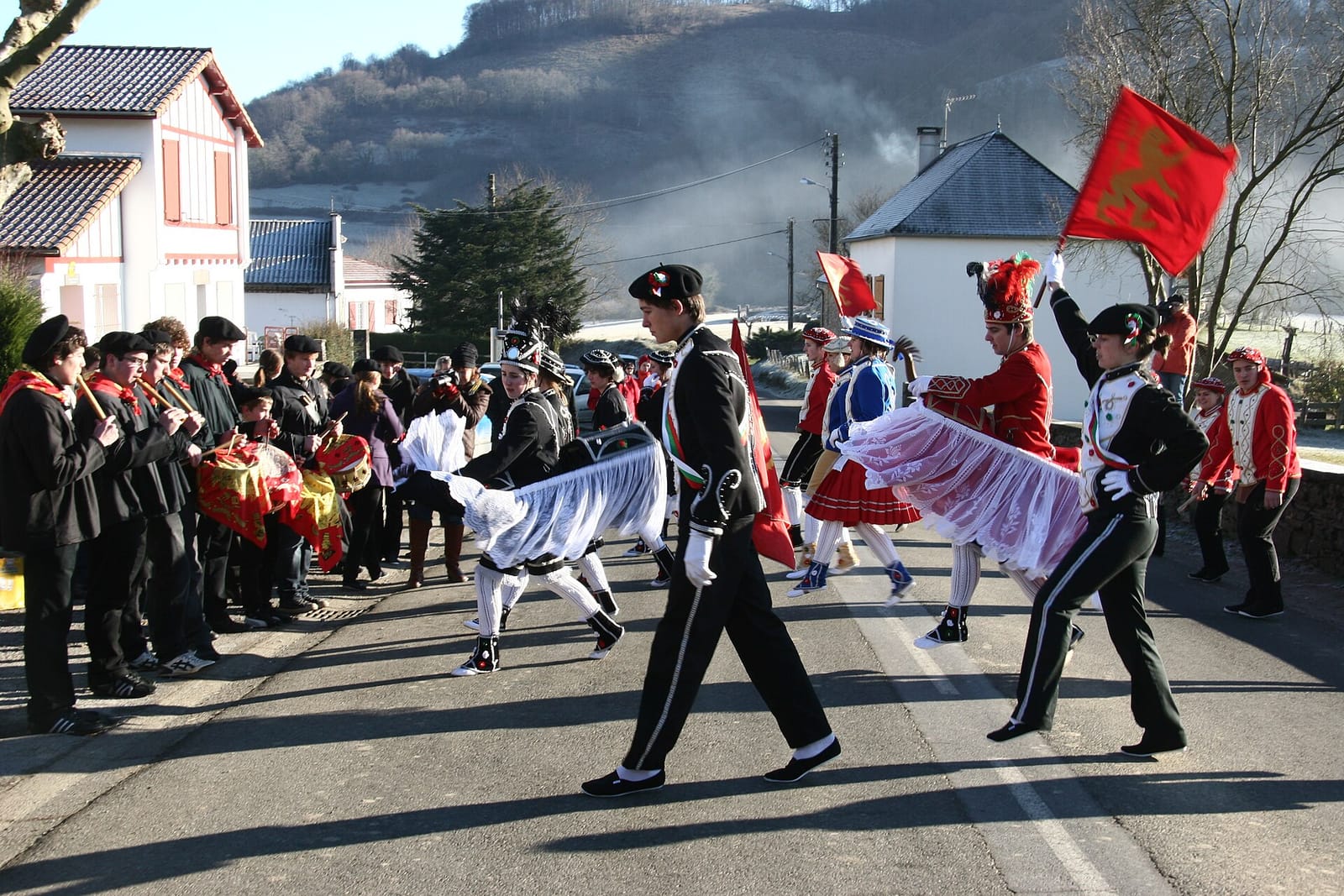
In Soule, the smallest of the Basque provinces, the young people of a village put on a Mascarade each year and perform it on Sundays from January to April, from village to village. It is danced theatre, and above all the moment when this usually sober country brings out its most loaded costumes.
The troupe splits into 2 camps. The Reds are dressed to the nines, in bright, frank colours: the Txerrero in red, black and white, bells at the waist, the Gatüzain in yellow trousers and a blue jacket, the Kantiniersa in a blue top and red skirt, a small cask at her belt, the Entseinari in black seamed with silver.
Facing them, the Blacks wear rags or skins. The Kauterak, the tinkers, have soot-blackened faces and a fox tail down their backs; the Buhameak, the gypsies, go in motley costumes. The clothes carry the whole story: order on one side, disorder on the other, and you know who is who before the first dance step.
The Zamalzain, the horse-man
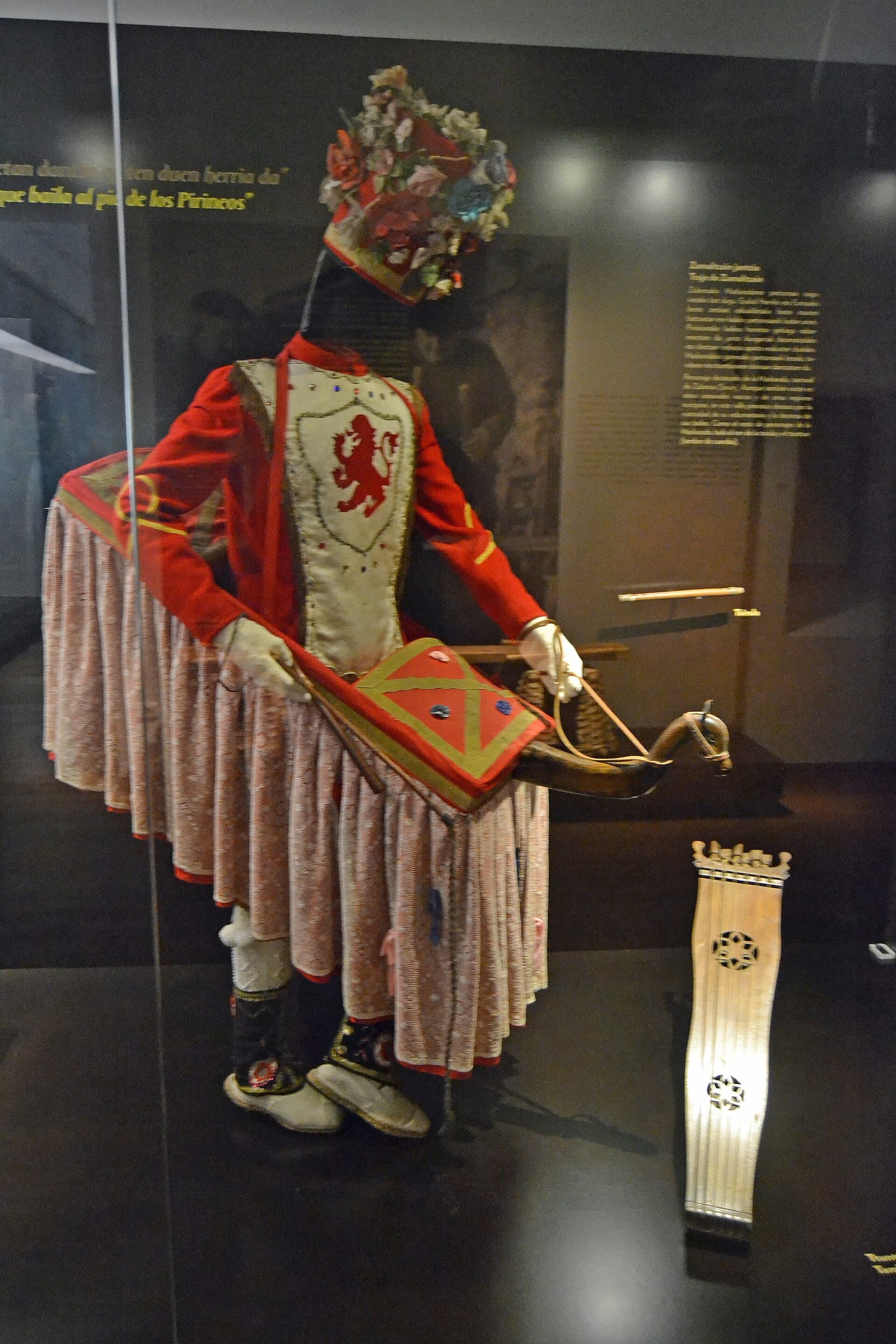
The most awaited character of the Mascarade is the Zamalzain, the horse-man, given to the village's best dancer. At hip height he wears a wooden frame held by a strap over the shoulders, standing for the animal's body, with a fine carved horse's head on a long curved neck at the front.
A lace petticoat hangs around the frame. Above it, a red jacket with the air of an operetta soldier, its white front embroidered in gold, tight trousers, gaiters and espadrilles. On his head, the koha: a tall red hat loaded with flowers, feathers and garlands, sometimes with a mirror on the forehead.
As he dances, he plays with that petticoat to bring the animal to life. The whole costume is made for movement, and that is what sets it apart from festive dress that is simply shown off.
A 2-colour sobriety
The Basque festive costume, that of the dancers and the Saint John's races, holds in 2 colours: white and red. White shirt and trousers, beret, red belt and neckerchief, espadrilles on the feet. Nothing more, and it is already a bearing.
People say the 7 stripes of the famous Basque linen represent the 7 provinces. It is a pretty story, but recent and commercial: originally, these stripes on the ox blankets served above all to tell one owner's cattle from another's. The brand invented the symbol after the fact.
It hardly matters, in the end. What remains is that taste for the little and the strong. 2 colours, a few well-made objects, an identity worn without piling it on. An elegance of red and white, frank as a handshake.

