Portuguese cotton
A natural, dense, legible material, chosen to avoid synthetics and keep a soft hand.
 Folkovar
A natural, dense, legible material, chosen to avoid synthetics and keep a soft hand.
Cables built into the knit, single thickness: lighter and more breathable than jacquard, for measured cold.
A lift-up band, a tighter mask, a long collar down the neck: the cut follows the cold and the gesture.
Heritage
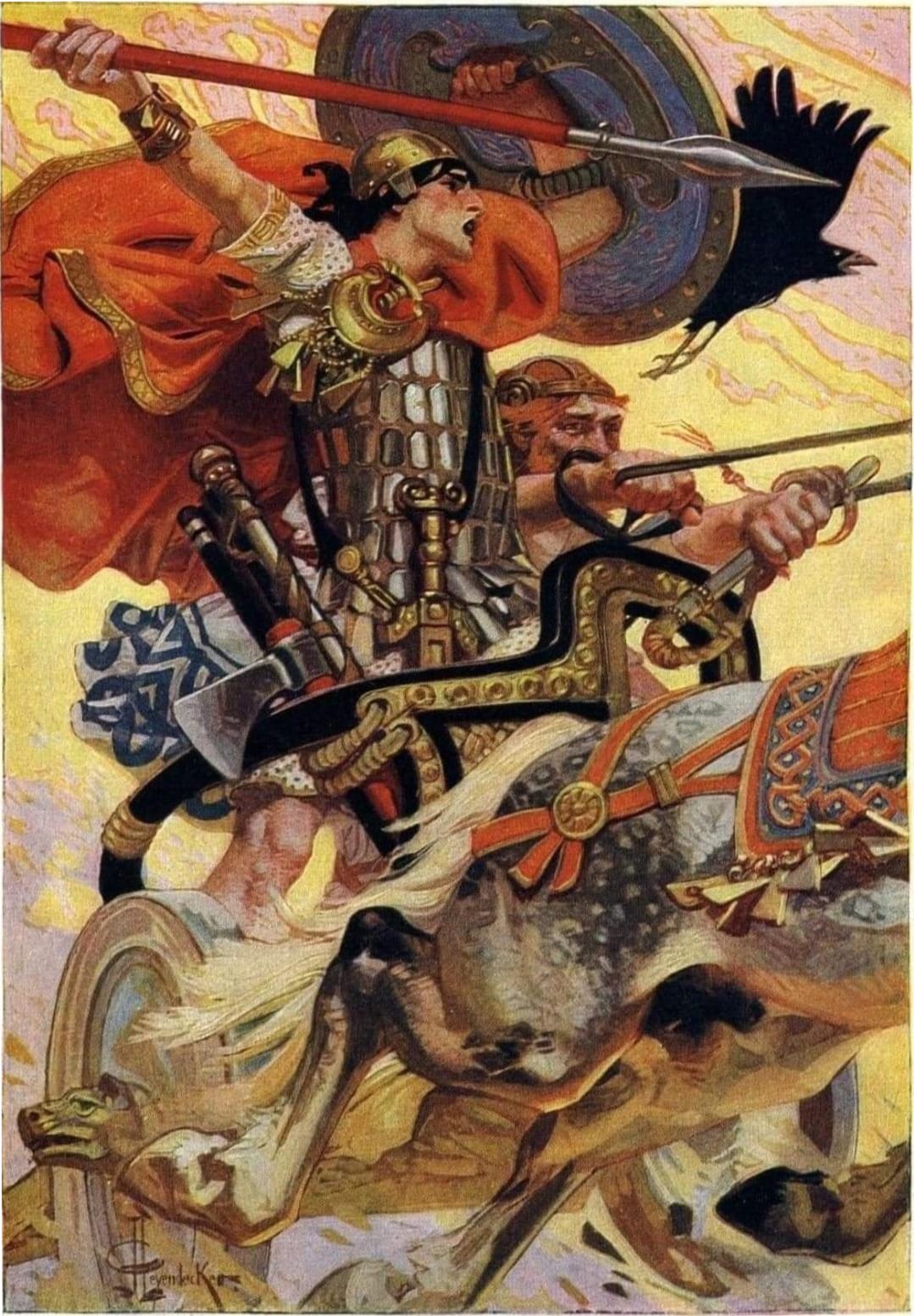
Ireland, Ulster Cycle
Morrígan means “Great Queen”, or “Phantom Queen” depending on the reading. In the Irish tales she foretells the outcome of battles and often takes the form of a crow.
When the hero Cú Chulainn dies on his feet, tied to a stone, his enemies only dare approach once a crow lands on his shoulder. Morrigan takes its name from her.

Aran Islands, around 1900
Off Galway, on the 3 Aran Islands, thick wools are knitted in tight, raised stitches. The cables recall ropes, the diamonds the meshes of fishing nets.
The Aran sweater as we know it dates from the early 20th century, and the story of a stitch unique to each family is mostly legend. Morrigan keeps the reliefs and knits them in cotton, in a single thickness.
Celtic traditions →The material
A balaclava is worn directly against the face and neck. Material is not a detail, so we chose Portuguese cotton for its softness, resilience and everyday simplicity.
Cotton feels soft against the face and neck, so the balaclava can be worn for hours without demanding attention.
A familiar material that is simple to wash and develops character with use rather than requiring complicated care.
We chose a clear cotton composition to keep synthetic fibres out of the garment as much as possible.
A dense Portuguese cotton, knitted to hold for years rather than a season. That's our answer to fast fashion.
It goes on and comes off through the day: rolled up into a beanie on the climb when you are warm, mask folded down as soon as you stop. The stop at a col, camp, sitting up in the evening, the face outside the sleeping bag, wind head on.
How we designed it →The piece · 01
Morrigan draws on Aran cables, the rope reliefs that knitters on the Irish islands worked by hand for generations. Each cable long had its own name and reading.
We brought them back onto a piece worn over the face, in Portuguese cotton knitted in the Ave valley. The relief structures the volume; the eye follows the cable.

The piece · 02
Unlike Skadi, Morrigan isn't double-thickness jacquard. The Aran knit, single thickness, breathes more.
That's an advantage when it isn't freezing: you keep the piece on without overheating, in mid-season or in the city, where double thickness would be too much.

FAQ
Morrigan is offered at €59 during the pre-order, then €65 once available in stock. Payment is taken at checkout.
No. Morrigan is 100% Portuguese cotton, knitted in the Ave valley. That is a choice, not a compromise: cotton is not an animal fibre, moths do not attack it, it washes at 30 °C without special care, and it never holds the smell of wet wool.
No, and that's intended. Morrigan is single-thickness Aran knit where Skadi is double-thickness jacquard: it breathes more, which makes it more versatile in mid-season and on cold days without frost. For the sharpest cold, take Skadi, Frosthelm or Caledon.
It depends on when the piece is worn. For a garment kept on during effort, merino tolerates moisture better. On a balaclava, which comes and goes through the day and sits against the face, other criteria decide: no animal fibre, no moths, a machine wash with no special care, better resistance to abrasion, and no synthetic fibre in the knit. Full comparison on our « Choosing your balaclava » page.
Not in the knit: 100% cotton — no elastane, no polyester, no acrylic. This is one of the few points where the difference is measurable: surface for surface, a fleece releases around 85 times more microfibres in the wash than a smooth synthetic fabric, and those fibres do not break down. Natural fibres shed microfibres too, but they biodegrade.
No. Cotton does not raise the irritation question that coarse wools do, where fibre diameter exceeds 30 microns. In fairness: a superfine merino under 20 microns does not itch either.
Yes. Morrigan is knitted in a workshop certified to OEKO-TEX® STANDARD 100 — certificate no. 6299CIT, issued by CITEVE. It covers product class I, the strictest of the 4: the class for articles used by babies under 3. In practice, every component has been tested for harmful substances against the lowest thresholds in the standard. On a piece worn directly against the face and nose, that felt like the least negotiable criterion. The certificate belongs to the workshop, not to us: it can be checked on the public OEKO-TEX register.
The knit is: 100% cotton, no animal material. No wool, no silk, no down. That leaves the label sewn inside, which still contains polyester. Not animal, but it stops us saying the piece is entirely natural. We are working on replacing it.
There is no wool in it, so the question doesn't arise: it's cotton. That said, let's be accurate. Wool is not an allergen. A review published in Acta Dermato-Venereologica in 2017 puts the discomfort down to fibre diameter, above roughly 30 microns, rather than an allergic reaction. A very fine merino doesn't itch either. So cotton fixes nothing medical. It just saves you the question.
That is what it is made for. Morrigan is worn like any balaclava: rolled up into a beanie on the climb when you are warm, mask folded down as soon as you stop. The stop at a col when warmth drops, camp, sitting up in the evening, the face outside the sleeping bag, wind head on. The openwork zone over the mouth lets the breath through instead of condensing it, which matters when you stay still for hours.
One piece does both. Headband rolled up, Morrigan is a plain beanie. Headband folded down, it closes the face and the neck. Switching takes one hand, with no need to remove gloves or hood, which saves carrying 2 accessories and hunting for them in the pack at the moment you get cold.
The knit is openwork over the mouth: the breath passes through instead of being pushed upwards, which limits fogging. No balaclava removes it entirely, but that is exactly what this zone is for.
The knit stretches and the pattern was adjusted over 4 prototype rounds. If Morrigan still does not fit, you have 14 days after delivery to send it back for a refund. The flat measurements are listed below so you can place yourself before ordering.
No, provided you wash it cold, 30 °C maximum, on a delicate cycle. What shrinks cotton is the tumble dryer: dry it flat. The double-thickness knit springs back on its own, it does not rely on elastane for that.
Morrigan is one size. The stretch knit fits most head sizes; the flat measurements are listed below.
Payment is taken at checkout, by Shopify. Production finishes on 13 November 2026 and shipping is announced for 1 December 2026. Should that date move, you would be told by email, and the 14-day right of withdrawal runs from delivery, not from the order.
Yes. You have a 14-day right of withdrawal after delivery, under French law.
Each piece is knitted in the Ave valley, northern Portugal, in a partner workshop. The pattern is built into the knit, not printed.
Priority access
Each new piece opens to the list 48 hours before the public. Plus the behind-the-scenes.


